
Lafayette City Directory Shelves
The core Lafayette city directory lead comes from the city architectural inventory. It states that Lafayette city directories from 1892-1978 are available at Carnegie Library for Local History and Lafayette Public Library. That is a valuable span, but it is not a promise that every year survives or that the books form an unbroken run. The inventory does not establish a publisher or compiler for the local volumes. Each title page, catalog record, and volume should therefore be checked before a year is treated as complete.
Several related collections widen the search. Boulder regional volumes include Lafayette in selected years, while a 1902 telephone subscribers record reaches Lafayette and other Boulder-area towns. Those are useful bridges, not replacements for a complete Lafayette city directory. The table separates the collections so a searcher can tell whether an item is a local directory, a regional volume, or a telephone list.
| Collection | Years | Publisher | Where Held | Access |
|---|---|---|---|---|
| Lafayette city directories | 1892-1978 stated by the city inventory | Not located in official sources | Carnegie Library for Local History and Lafayette Public Library | In person; confirm each year and volume |
| Boulder regional directory volumes | 1926, 1928, 1930, 1932 | Not located on the NARA page | National Archives city-directory resource | Regional volumes include Lafayette |
| A. A. Paddock telephone subscribers directory | 1902 | Publisher not located; A. A. Paddock collection | Carnegie digital archive | Digitized item; not a full city directory |
| Reverse or criss-cross directory | Exact Lafayette run not located | Not located | Ask Carnegie or Lafayette Library staff | Catalog check and in-person help needed |
No source establishes publisher continuity, a year-by-year inventory, or a final printed year inside the 1892-1978 span. That gap belongs in the research notes. A missing volume may be a cataloging issue, a restricted item, or a year that was never located. It should not be silently filled with a familiar commercial publisher name.
Note: Treat the stated 1892-1978 span as a shelf lead, not proof that every Lafayette volume or publisher survives.
Carnegie Search Filters for Lafayette City Directories
Carnegie’s digital archive is useful when a Lafayette city directory has been cataloged as part of a broader local-history collection. Its Advanced Search lets a researcher change the field being searched instead of relying on a single surname box. Title and subject searches can find a directory, while call number and author-donor searches can surface a collection record whose title does not name a resident.
The archive also separates discovery from online access. An item may have a digitized page, metadata only, or a restriction noted at the item level. Search terms should be tried with a surname, a street, Lafayette, a business name, and a year. Exact phrase and all-words modes behave differently, so a failed exact search is not proof that the collection is absent.
| Search field selector | Keyword, Title, Subject, Call Number, or Author/Donor. |
|---|---|
| Search text | Enter a name, place, street, collection term, or other phrase. |
| Match mode | Starts with, All the words, Exact phrase, At least one, or Without these words. |
| Accessible online | Toggle the option to limit results to items viewable online. |
| From / To | Use four-digit year fields to narrow the date range. |
| Formats | Choose from the archive’s dynamically supplied format choices. |
The Carnegie digital archive landing page shows how local-history material is grouped before a person-name search begins.
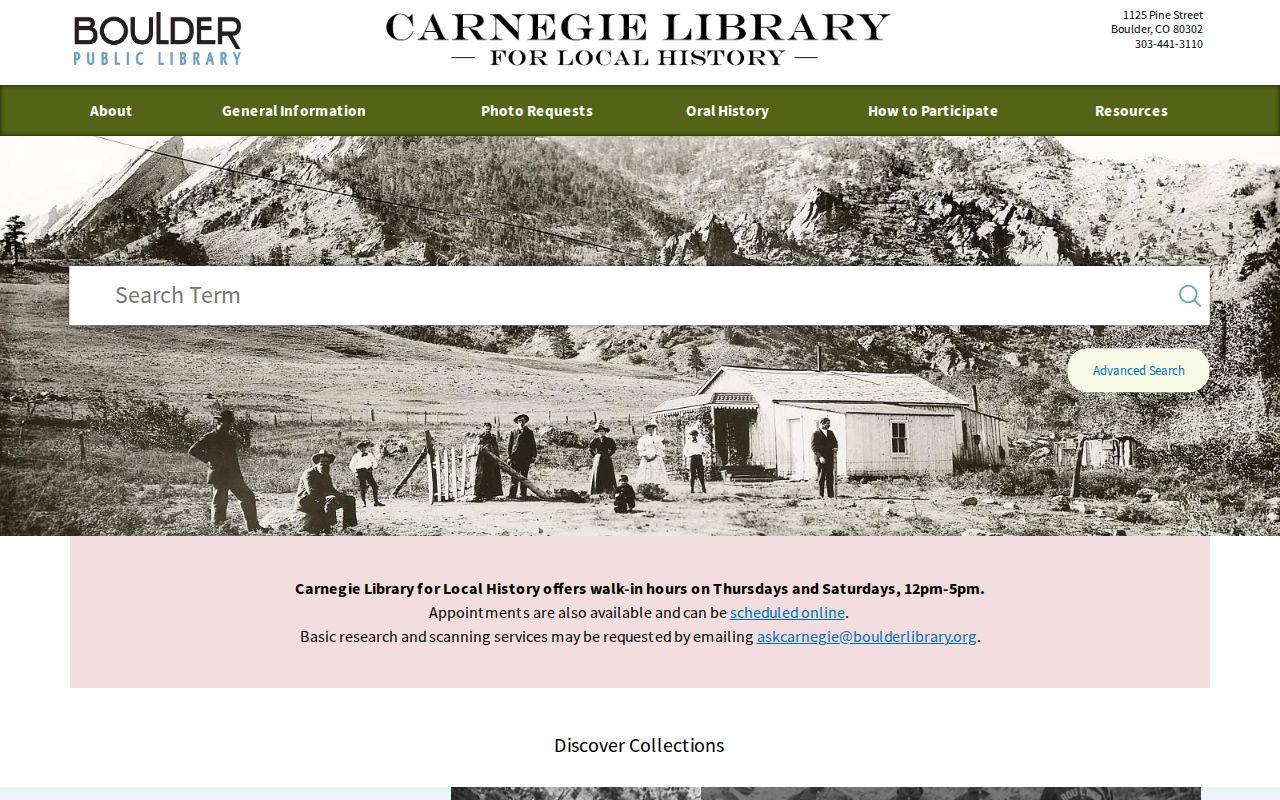
That archive view is a reminder to record the item title, date, call number, access status, and attribution before relying on a scan.
Regional City Directories That Name Lafayette
The National Archives city-directory resource identifies Boulder directory volumes for 1926, 1928, 1930, and 1932 that include Lafayette and nearby communities. These volumes matter when a local Lafayette city directory is missing or when a household moved between towns. They can supply a name and address for a particular publication year, but the regional label should remain visible in research notes.
The NARA page does not establish a local publisher for those Boulder volumes. The same caution applies to the Lafayette shelf. Use a page image, title page, or catalog record to identify the city coverage and source, then compare the entry with a local paper, census record, or deed clue. A regional directory is evidence of a publication snapshot, not proof that every Lafayette household appears.
| 1892-1978 | The city inventory states that Lafayette city directories are held at Carnegie and Lafayette Public Library; continuity by year remains unverified. |
|---|---|
| 1902 | The A. A. Paddock telephone subscribers record lists Lafayette among Boulder-area communities and is not a full city directory. |
| 1926, 1928, 1930, 1932 | NARA’s Boulder regional directory page identifies volumes that include Lafayette. |
| 1955 | The city architectural inventory cites a Lafayette Jewelry entry at 109 South Public Road and explains a 101/109 renumbering. |
Note: A regional volume can bridge a missing Lafayette year, but its coverage and publication city must stay attached to the citation.
Reading a Lafayette City Directory Entry
A Lafayette city directory entry should be read as a dated record with a particular publisher’s conventions. Start with the title page and the abbreviation key. Then copy the name, street number, street suffix, business or occupation line, household notation, and page reference exactly as printed. Do not turn a missing mark into a fact. The open research sample does not expose a complete local entry with every requested field, so the inventory below describes what to look for rather than promising that every volume carries each item.
| Name | The person or household line as printed, including initials and spelling. |
|---|---|
| Address | House number and street, with the historical suffix and any cross-reference. |
| Occupation or business | Use only the line shown in that volume; wording can change by year. |
| Spouse or household notation | Record parentheses, widow notes, boarding references, or other marks only when visible. |
| Occupancy mark | Check the volume’s own key before assigning meaning to a symbol. |
- Criss-cross directory
- An address-ordered section that can point from a street or house number to an occupant; an exact Lafayette run was not located.
- Householder index
- A name-led arrangement that helps locate a head of household or listed resident before checking the address section.
- Abbreviation key
- The volume’s explanation of short forms and symbols; photograph or transcribe it before interpreting an entry.
A telephone number can add a useful one-year connection, but a phone listing is not a deed, an occupancy record, or a complete list of people in a house. The safest note pairs the exact page with the volume year and the kind of directory used.
A Lafayette City Directory Address Quirk
Lafayette’s historic address system can make a good city directory search look wrong. The city architectural inventory describes a 1950s renumbering on South Public Road and cites the 1955 directory’s listing of Lafayette Jewelry at 109 South Public Road. The same discussion connects the older 101 number with the later 109 number. That is a cited sample clue, not a complete directory entry or a claim about every address on the block.
Bridge the two numbers with the business name, neighboring addresses, the historic survey, a parcel map, and the legal description. A street suffix or number can change while the lot, building, or nearby landmarks remain stable. Record both numbers in a worksheet and mark which one belongs to the publication year. That small step keeps a modern lookup from erasing a historical place.
Insider tip. Save the historical number, modern number, business clue, and legal description together before moving from a directory to another record set.
Lafayette Library Routes Around Missing City Directories
Lafayette Public Library’s genealogy resources are the practical first stop when a city directory year is not online. They include newspaper microfilm, bound and online newspapers, historical photographs, an online oral-history collection, genealogy books and statewide borrowing. Ancestry Library Edition is available in the library, while MyHeritage is available in the library and remotely with a Lafayette library card. These are research tools, not custodians of a complete modern resident roll.
Carnegie Library for Local History is the county-level research room. It is at 1125 Pine Street, Boulder, Colorado 80302, with 303-441-3110 and askcarnegie@boulderlibrary.org. Documented access includes walk-in hours Thursday and Saturday noon-5, plus appointments Tuesday 10-noon and 1-4, Thursday 10-noon, and Saturday 10-noon. Ask about scanning, restricted items, and a catalog search for a reverse directory before planning a visit.
Lafayette Public Library
775 W Baseline Road
Lafayette, CO 80026
303-665-5200
Monday-Thursday 10-8; Friday-Saturday 10-5; Sunday 1-5.
Carnegie Local History
1125 Pine Street
Boulder, CO 80302
303-441-3110
Research and scanning: askcarnegie@boulderlibrary.org. Walk-in and appointment hours vary by day.
City Archives
Lafayette Archives policy describes correspondence, minutes, reports, maps, photographs, scrapbooks, audio/video, and digital material.
Request by record series, date, and topic rather than assuming a name index exists.
The access chain is therefore broader than a scan: search the archive, call or visit the library, request Carnegie staff help, and ask the City Archives about municipal material. Library microfilm and bound newspapers can fill the years that a directory shelf does not.
Lafayette History Museum and City Directory Context
The Lafayette History Museum and Lewis Home add local context to names that appear in a city directory. The museum’s research holdings concern coal mining, farming, community change, and the 1890s Lewis coal-miner cottage. It is at 108 E Simpson Street, Lafayette, Colorado 80026. Documented hours are Wednesday-Friday 10-2 and Saturday 8-12; the listed contact is 303-665-7030 and info@lafayettehistoricalsociety.org. Contact staff for collection guidance instead of assuming that the museum maintains a searchable surname list.
Coal-era names can also lead to UMWA Local 1388 minutes, Congregational Church material, Odd Fellows minutes from about 1900-1950, mine records, oral histories, and the Rocky Mountain Fuel Company collection at Denver Public Library Western History. Some of these records are unindexed or require archivist help. Their value is in confirming a community connection around a dated directory entry, not in replacing the directory itself.
The museum’s holdings and a directory page should be cited separately. One can explain the local setting; the other supplies the printed name, address, or business clue. That distinction matters when a family history later reaches a newspaper, school census, or naturalization file.
The Lafayette Historical Society’s collection page gives a visual look at the museum and Lewis Home holdings.

The image places directory clues in the coal, farming, and community setting described by local historical materials.
When a Lafayette Telephone Directory Is Different
Carnegie’s 1902 A. A. Paddock telephone subscribers record is a useful example of why record type must be named. The catalog record covers Boulder, Broomfield, Eldora, Erie, Lafayette, Longmont, Louisville, Lyons, Wallstreet, and Ward. It contains alphabetical subscriber listings and telephone numbers. It is not a full city directory with a complete population, occupation, or household list, and a subscriber entry is not proof of ownership or continuous residence.
The item is held in the Carnegie digital archive under call number BHS 328-O-2. Check the item record for its date, collection, geographic coverage, attribution, and any access restriction. A single telephone number can help connect a person or business to a year, but it should be paired with a newspaper, directory entry, address record, or family source before drawing a longer conclusion.
The Carnegie record for the 1902 telephone subscribers directory shows the catalog-level evidence behind that distinction.
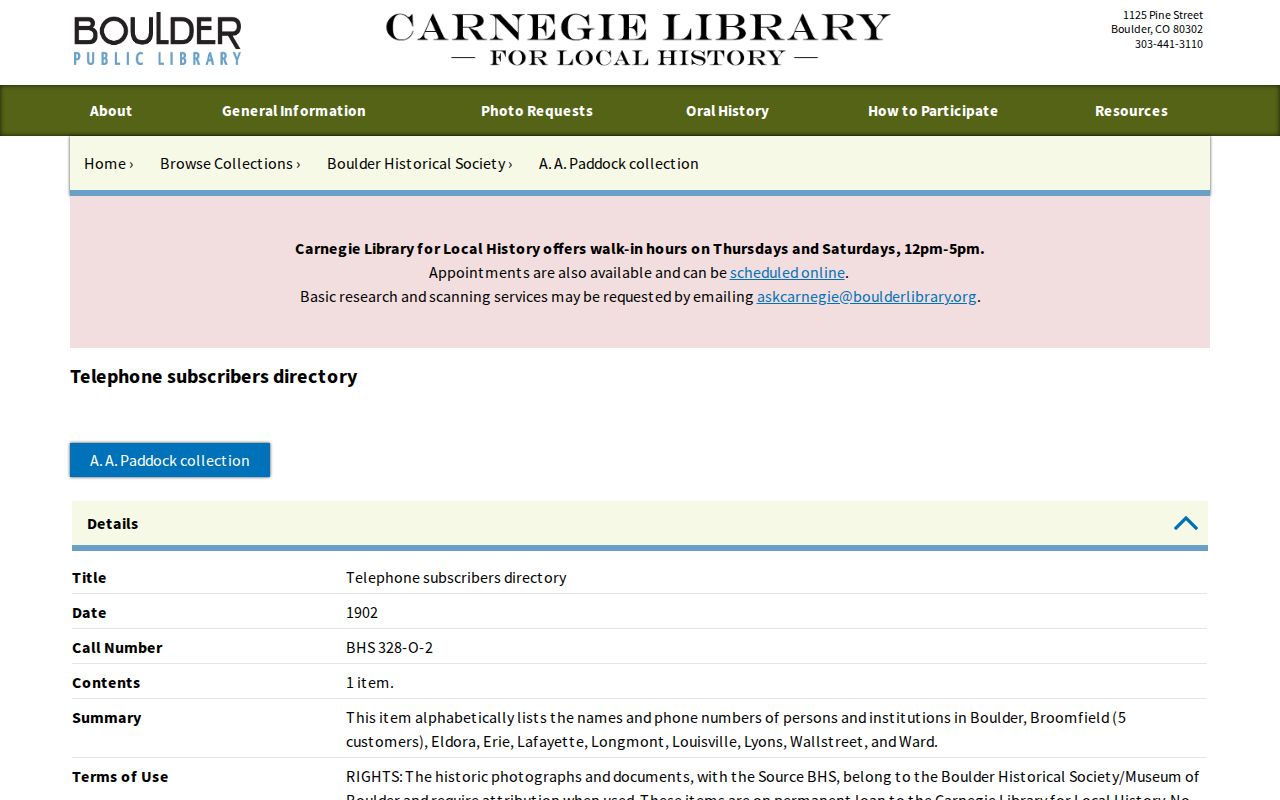
The sample is best used as a dated telephone clue, while the local Lafayette city directory shelf remains the source for directory conventions and year-to-year household tracing.
Myth to avoid. A telephone subscribers list is not the same thing as a complete Lafayette city directory, even when both contain names and addresses.
Tracing a Family Through Lafayette City Directories
A Lafayette city directory becomes more useful when each appearance is placed in a dated chain. Start with the clearest name and address, then test spelling, initials, spouse or relative names, business terms, and nearby streets. The nearest census can anchor a household at a broad interval, while a directory fills a publication-season gap between census dates. Do not treat a disappearance as a death without checking for a move, an unlisted telephone, a changed surname, or a missing year.
- Find the first plausible directory entry and copy the name, address, volume year, page, and any printed notation.
- Search later years with spelling variants, initials, spouse or relative names, and the prior street address.
- Check the street-order or criss-cross section if a volume has one, then validate the occupant in the alphabetical section.
- Pair each directory year with the nearest federal census or the Lafayette School Census District 52 publication for 1888-1900.
- Close a life-event gap with the Daily Camera obituary indexes, cemetery records, newspapers, or a State Archives record.
For each year, keep a separate row for the printed source and a separate note for an inference. A changed house number deserves the same care as a changed surname. When the question turns from a historical household to current address evidence, the Lafayette street address directory handles the modern street-record angle.
Lafayette City Directory Clues Beyond the Books
Historical directory research is strongest when a second local source answers a different question. Newspapers may confirm a business, address, marriage, death, or civic event. A school census can place a child or household in a precise local district. Naturalization records can explain alternate names, while church, fraternal, union, and coal collections can identify the community ties that a short directory line leaves out.
- Daily Camera obituary indexes cover 1901-1910 and selected 1950s-1970s years; Carnegie provides access to full obituaries from 1975-2017.
- The Boulder Genealogical Society publication for Lafayette School Census District 52 covers 1888-1900 and can bridge early directory and census work.
- Colorado State Archives naturalization records include Boulder County index and declarations from 1872-1958, final documents from 1879-1958, certificate stubs from 1907-1929, and petitions from 1903-1906 and 1930-1958.
- UMWA Local 1388, Congregational Church, Odd Fellows, mining, and oral-history records can add a community connection when item-level access is available.
- The State Archives catalog can be searched by title, creator, dates, category, archival level, and archive number when a directory trail points beyond Lafayette.
Newspapers, photographs, oral histories, and archive material also have different access paths. Use the Lafayette Library’s microfilm, bound volumes, online newspaper route, in-library Ancestry access, and card-based MyHeritage access as appropriate. For a modern name check after a historical clue, the Lafayette resident lookup page separates current verification from the historical shelf.
Note: A catalog record can identify a valuable collection without proving that every item or directory year is digitized and open.