
What a Lafayette Resident Lookup Can Confirm
A useful resident lookup begins by naming the record question. The county property roll can confirm an assessed owner, parcel, legal description, and mailing address. A voter report can show allowed registration fields. A court docket can show a party name, case number, hearing, and courtroom. A vital-record application can lead to an eligible certificate, while a directory or obituary can supply historical context. No row below is a complete list of Lafayette residents.
| Record | What it can confirm | Where to search | Access |
|---|---|---|---|
| Property roll | Assessed owner, situs, mailing and legal fields | Boulder Property Search | Free current search |
| Voter report | Name, public address, status, party, birth year and precinct fields | Boulder Elections | Download or request |
| Court docket | Party, case number, hearing type, date and location | Colorado Judicial Branch | Public row; file limits |
| Vital record | Birth, death, marriage, adoption or divorce event when eligible | CDPHE, county, court or Archives | Confidential; ID and eligibility |
| Business or license | Entity, registered role, credential or status | Colorado SOS or DORA | Public current registry |
| Historical collection | Past address, occupation, relatives, obituary or community tie | Library, Carnegie or archive | Collection-specific |
Use the property roll for a parcel clue, the court portal for a case clue, and the library for a past-person clue. When the question shifts from one name to everyone along a road, the by-address records belong on the Lafayette street directory page.
Note: A resident lookup result is strongest when its custodian, date, and record type travel with the name.
Lafayette Name Match Needs Two Clues
A same-name problem is common in Lafayette because a search may return several parcels, docket rows, entities, or directory entries. Use at least two independent identifiers before treating records as one person. A full name plus birth year is useful. So are a name plus legal description, spouse or relative, business ID, court case number, license number, cemetery date, or directory year.
- Write down the name exactly as found, including initials, hyphens, suffixes, maiden or married forms, and entity endings.
- Search Boulder Property Search and save every account, parcel, situs, mailing address, and legal description that could fit.
- Compare the allowed voter report by name, address, status, birth year, party date, or precinct without seeking excluded fields.
- Use the court docket or a state registry only when the record type fits the question. Save the case, entity, or license number.
- Confirm the match with a second source, then request a certified or official copy only from the proper custodian.
Phone calls can confirm which office holds a record and which form is current. Staff should not disclose a protected fact simply because a caller knows a name. Ask for the correct route, not an informal reveal.
Lafayette Property Lookup: Owner and Mailing
Boulder County Property Search accepts owner, address, street, subdivision, account, parcel, and S-T-R searches. Its result may include the physical address, owner, mailing address, legal description, account, parcel, subdivision, neighborhood, market area, estimated land, and value or building fields. Save the legal description before moving to the recording index. That field can survive a number change, a spelling change, or a shift from a street label to a subdivision description.
The assessed owner is not automatically the person who lives there. A trust, LLC, estate, business, or out-of-area mailing contact may appear. A tax mailing address is not the same as a situs address. A property card is therefore a strong link between a person and place, but only one part of a resident lookup.
| Field | Use and caution |
|---|---|
| Owner | County assessed owner; test entity and name variants. |
| Situs or Address | Physical parcel location; check nearby jurisdictions. |
| Mailing Address | Tax-notice destination; can differ from the situs. |
| Legal Description | Bridge to a deed, plat, subdivision, or older record. |
| Account and Parcel | Stable identifiers for repeat searches and requests. |
Note: Owner, mailing, and situs fields connect a name to a parcel, not necessarily to a current household.
Lafayette Court Lookup: Dockets and Names
The Boulder County docket route is the Colorado Judicial Branch search filtered to county 7. Its fields include location, judicial district, county, courthouse, court type, division, date range, a specific date, four-digit year, case class, case sequence, party mode, first and last name, business name, attorney name, and attorney bar number. A search needs a date or another filter. Results show hearing date and time, duration, name, case number, hearing type, location, appearance type, and courtroom.
Use the case number as the next identifier. The public row is not a certified disposition and does not expose every document. Sealed, juvenile, suppressed, protected, or otherwise restricted material may be absent. Lafayette Municipal Court is separate and handles city-code, traffic, parking, animal, and related limited matters. Its form asks for defendant, case or citation number, DOB, requester details, and document type.
The Colorado Judicial record and document request form shows the fields and document choices used after a case-number lead is found.
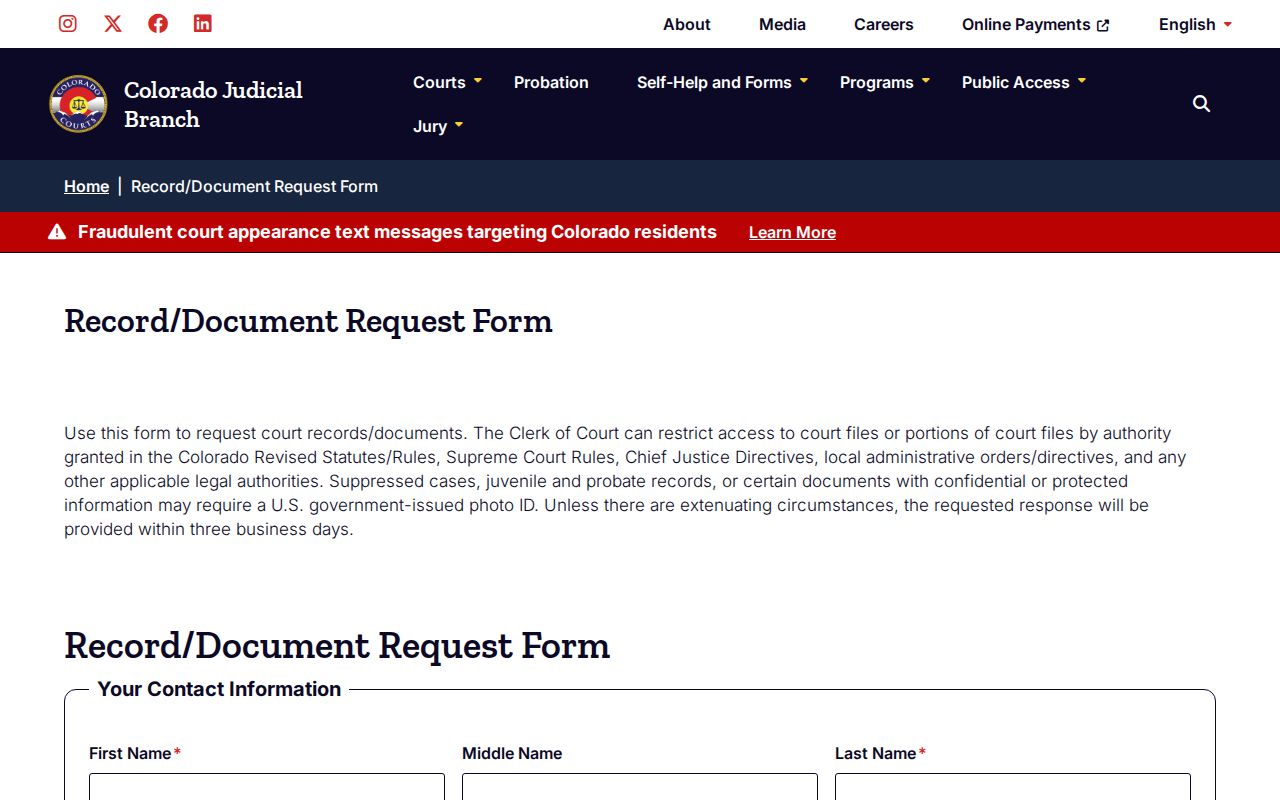
The request form is the handoff from a public index to a custodian-controlled document request. It does not turn a name match into an unrestricted file.
- Docket
- A court's public case and hearing index. It may show the case path without showing every filing.
- Index versus image
- An index gives finding fields; an image is the document view, which may be watermarked, restricted, or fee-based.
- Certified copy
- A copy issued or attested by the custodian as an official copy for a permitted purpose.
Lafayette Voter Lookup Has Defined Fields
Boulder County's standard Registered Voter Data report comes from Colorado's SCORE system and is updated monthly by the first of the month. Public fields can include voter ID, name, residential and mailing address, city, state, ZIP, phone if supplied, registration date, party and affiliation date, active or inactive status, gender, birth year, and precinct or district. The county also describes Master Voter History and election-period ballot reports with different update schedules.
Confidential voters and Address Confidentiality Program participants are omitted from ordinary reports. Colorado public voter data does not include SSN, driver's-license or ID number, full birth date, signature, or email. A report can include an inactive record and does not show ballot choice. Filter only the allowed report, record its date, and treat a hit as a registration connection rather than proof of current occupancy.
The county's other-data request is the fallback for a field not in a standard download. Local elections staff can explain the current form, confidentiality process, and fee route. Do not try to reconstruct a protected address from other public clues.
Lafayette Vital Record Lookup Needs Eligibility
Colorado vital-statistics records are confidential under C.R.S. §25-2-117. CDPHE states that birth, death, adoption, marriage, and divorce records are not an open public name-search database. A current birth or death application goes through CDPHE or the relevant local office. Boulder County Clerk and Recorder handles marriage and civil-union licensing. District-court clerks hold divorce, separation, and annulment files. Older Boulder material may be in the Colorado State Archives.
An applicant may need identity, a relationship or direct and tangible interest, event details, payment, and the right application channel. The Archives birth policy requires records to be at least 100 years old for its historical access route, while post-1908 birth and death certificates generally go to CDPHE. No universal opening rule for every death or marriage series was located, so do not promise one.
Use an obituary, census index, directory, cemetery record, or newspaper to identify an event, then ask the lawful custodian for the eligible copy. A secondary index is not a certificate.
Note: Eligibility is part of the vital-record result; a historical clue cannot replace the custodian’s release rules.
Lafayette Resident Business and License Context
The Colorado Secretary of State database can search business names, trade names, trademarks, ID numbers, and document numbers. Advanced Search includes filing dates, exact-name controls, registered-agent fields, reserved-name holders, trade-name registrants, trademark registrants, and organization names. A person may appear as an agent or registrant without being the owner of a home or a resident of Lafayette.
DORA MyVerification accepts profession, first or middle name, license type, last name, license number, and status, with wildcard use after partial information. A license number is a strong way to separate two people with the same name. The local MuniRevs portal handles Lafayette business tax filing, but no public browsable licensee roster was located. Request a named city record through the Clerk when needed.
Business and license sources are affiliations. Pair them with a date, city, parcel, case, or historical collection before calling the connection local.
Lafayette Resident Lookup for Heirs
A Lafayette resident lookup can support a lawful family-history question when the record path matches the goal. For an heir lead, start with an obituary or cemetery clue, identify a probate case in the Boulder court system, and request only filings available under judicial access rules. Probate may name a personal representative, heir, or attorney, but protected material can remain closed.
For a former classmate, use yearbooks, Lafayette Library, Carnegie, oral histories, newspapers, and city directories. The result should be a historical connection, not an attempt to expose a private current address. The library's licensed Ancestry Library Edition and MyHeritage access can help researchers work from a school year, relative, or old city entry.
Birth-parent research must use CDPHE's adoption-information route and C.R.S. §19-5-305. Adult adoptee, adoptive-parent, minor, and qualifying birth-parent access depends on the statute, consent, and proof. A shared surname or obituary relationship is not birth-parent confirmation.
The 1892-1978 Lafayette city-directory run, 1902 telephone record, Daily Camera indexes, School Census District 52 publication for 1888-1900, and local church, mine, and fraternal collections can bridge a past-person search. The historical shelf is covered on the Lafayette city directory collections page.
Lafayette Resident Records That Need a Request
Not every Lafayette record is online. For county material, search the database first, then use the Boulder County Open Records Center under the Colorado Open Records Act, C.R.S. §§24-72-201 to 206, especially §24-72-203. Put the exact name, address, parcel, account, case number, date span, and document type in the request. A narrow request helps the custodian find the right file and quote the right fee.
City-held records go to the Lafayette City Clerk. Police and Municipal Court keep their own files. Building, code, cemetery, Sheriff, court, vital, library, and Archives records have separate custodians. Use phone, email, mail, an in-person counter or terminal, and library or archive staff when a portal stops. The official fallback is a change of channel, not permission to fill a gap with an unverified private listing.
For a correction, contact the office that created the record. The Assessor accepts owner-name typo and mailing-address corrections by its documented routes. Court corrections go to the clerk. Voter corrections go to Elections. A suspected deed fraud goes to Recording and the Sheriff, with PropertyAlert as a notice tool.
Legal Limits on a Lafayette Resident Lookup
A Lafayette resident lookup is for lawful personal research, family history, civic curiosity, and record verification. Colorado Address Confidentiality Program participants, confidential voters, vital-record applicants, juvenile parties, sealed matters, adoption records, and protected court material have specific safeguards. The federal Driver's Privacy Protection Act also limits motor-vehicle personal data. A public record is not a license to assemble or publish a private profile.
Lawful use. Use a Lafayette resident lookup to verify a permitted record or pursue a personal history question. Do not use public data to stalk, harass, threaten, monitor, or harm anyone.
When the record is uncertain, stop at the record boundary. Ask the custodian what can be released, keep the source and date with the result, and avoid repeating details that the official system excludes.